 EN
 VI
 ZH
Shipping refrigerated containers by sea helps businesses maintain the quality of temperature-sensitive goods on international routes. However, selecting the wrong temperature setting, equipment type, or power supply arrangement can result in significant losses. Below is a reference temperature chart, container specifications, and cold chain control procedures for import-export businesses.
1. Sea Freight Refrigerated Container Shipping: Preservation Principles and Standard Temperature Chart
1.1. Refrigerated Container Temperature Chart by Export and Import Cargo Category
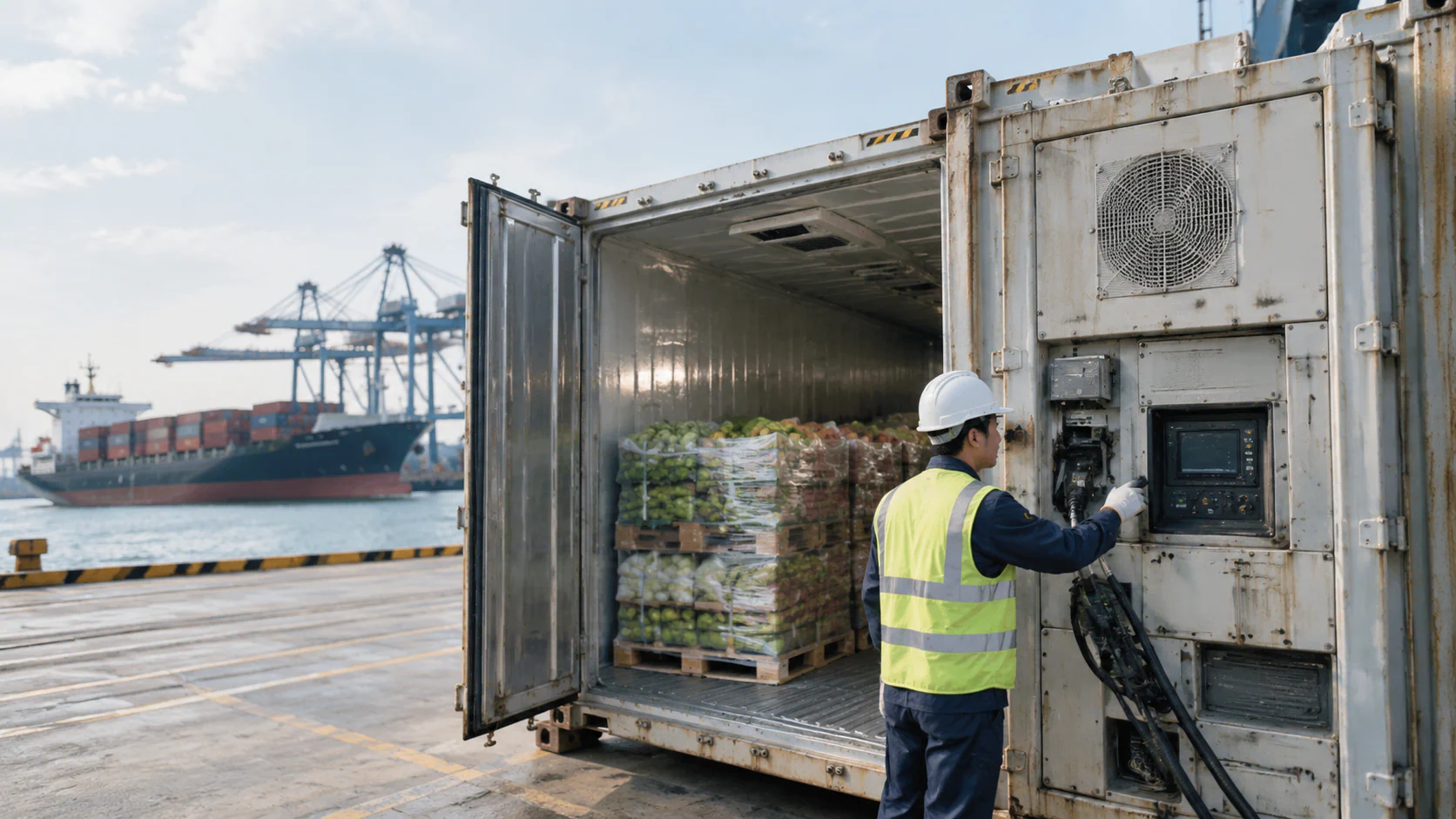
Refrigerated container temperatures depend on the biological characteristics, storage conditions, and quality requirements of each product. Chilled goods generally require above-zero temperatures, while frozen goods must be maintained at below-zero temperatures. The ranges below are for reference only and do not replace the instructions provided by manufacturers or cargo owners.
| Cargo Category | Reference Temperature | Storage Notes |
|---|---|---|
| Frozen Seafood | -18°C to -25°C | Pre-freeze goods before loading; some products require lower temperatures. |
| Frozen Meat | -18°C to -25°C | Minimize temperature fluctuations and the risk of thawing. |
| Fresh Fruits | 0°C to +13°C | Depending on the variety, ripeness, and cold tolerance; bananas generally require approximately +12°C to +14°C. |
| Fresh Vegetables | 0°C to +13°C | Adjust according to each type to prevent moisture loss or chilling injury. |
| Processed Foods | 0°C to +4°C or -18°C and below | Distinguish between chilled and frozen products according to their labels. |
| Temperature-Sensitive Pharmaceuticals | Typically +2°C to +8°C | Depends on stability documentation, GDP requirements, and qualified equipment. |
Set Point is the temperature configured on the controller, not the actual temperature of the entire cargo shipment. Supply Air indicates the temperature of the outgoing air, while Return Air indicates the temperature of the returning air. The core temperature of products must be measured using an appropriate method. Differences between these readings should be evaluated based on operating conditions and cargo status.
Refrigerated containers primarily maintain an established storage environment and do not automatically replace factory refrigeration or freezing systems. Therefore, cargo owners must check product temperatures before container loading, particularly for seafood, meat, and foods with strict storage requirements.
1.2. Temperature, Ventilation, and Humidity Control Mechanisms During Sea Freight
The refrigeration system uses a compressor, fans, and sensors to regulate conditions inside the container. Air is distributed through the T-shaped floor, follows the designed circulation path, and returns to the refrigeration unit. Cooling efficiency depends on cargo arrangement, packaging, and available airflow space.
Frozen goods generally require external ventilation to remain closed to limit heat and moisture loads. Conversely, fresh produce that continues to respire may require gas exchange to control oxygen, carbon dioxide, and ethylene levels. Some equipment supports humidity or controlled-atmosphere adjustments, but actual capabilities must be confirmed before booking.
Before accepting a container, check the Pre-trip Inspection (PTI) results, refrigeration unit condition, sensors, door seals, floor, and power connection capability. At the same time, agree on temperature data recording methods, monitoring intervals, and record-keeping responsibilities to support traceability when alerts or claims arise.
2. 20-Foot Refrigerated Containers, 40-Foot Refrigerated Containers, and 40HC: Equipment Selection Criteria
2.1. Comparison Table of Operating Specifications and Loading Capacity
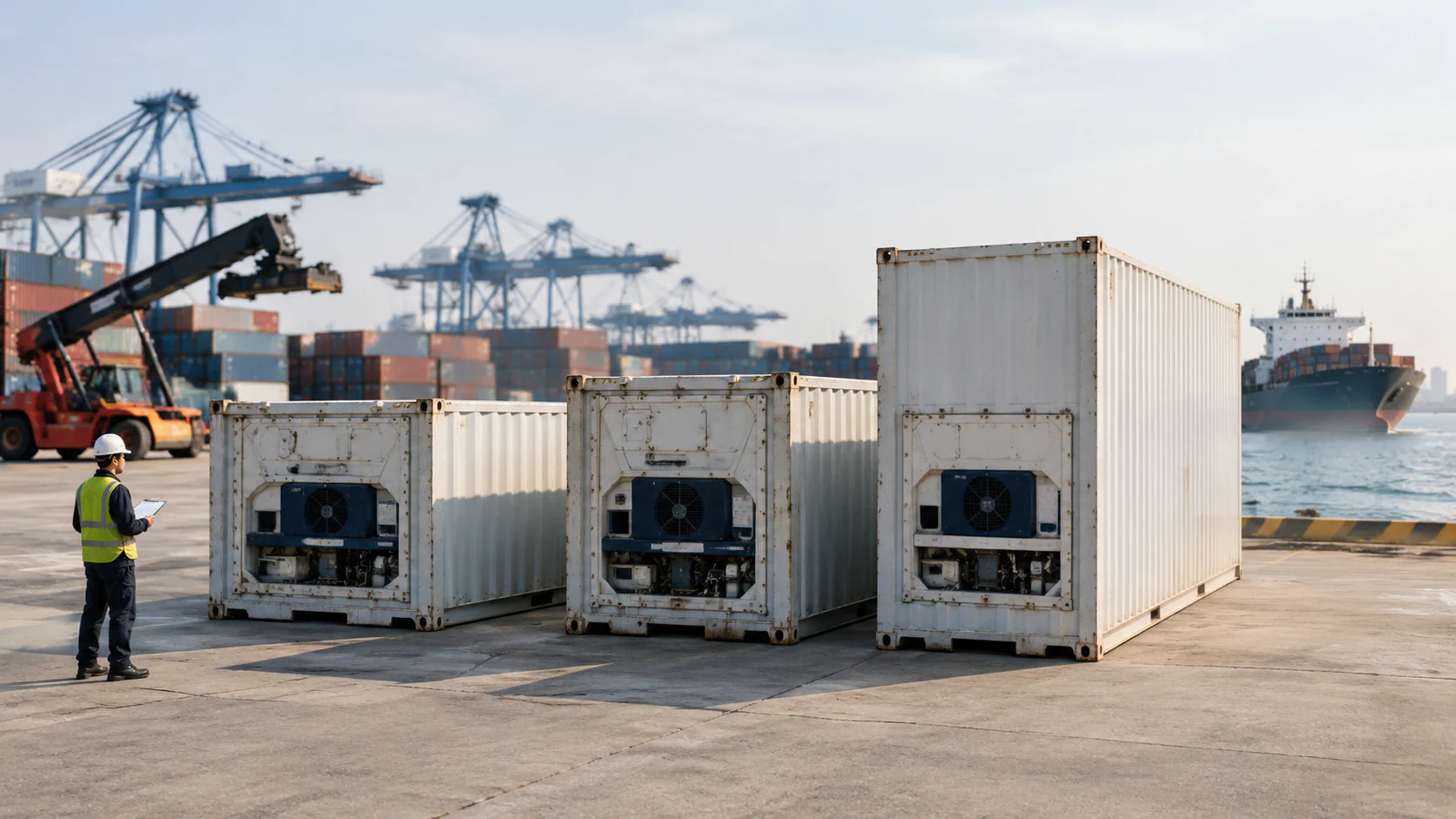
20-foot refrigerated containers are suitable for many shipments requiring controlled cargo weight and delivery schedules. 40-foot refrigerated containers provide more loading space, while the High Cube (40HC) type offers additional height. A standard 40-foot high container is not necessarily equivalent to a 40HC reefer because insulation construction and refrigeration equipment affect usable capacity.
| Reference Specifications | 20RF | 40HC Reefer |
|---|---|---|
| Internal Dimensions (L × W × H) | 5,456 × 2,294 × 2,273 m | 11,584 × 2,294 × 2,557 m |
| Nominal Capacity | 28.6 m³ | 68 m³ |
| Usable Capacity Below the Cargo Loading Limit | 27.3 m³ | Approximately 65 m³ |
| Reference Tare Weight | 3,010 kg | 4,700 kg |
| Reference Maximum Payload | 27,470 kg | 29,300 kg |
| Reference Maximum Gross Weight | 30,480 kg | 34,000 kg |
The above specifications are compiled from CMA CGM shipping line equipment documentation and may vary depending on the container series. Before loading, verify the tare weight, permitted payload, and specification sheet of the actual container. CBM capacity does not fully reflect operational loading capability because floor restrictions, loading height, and airflow circulation must also be considered.
Booking information should specify the cargo type, number of packages, weight, pallet dimensions, required temperature, port of loading, and port of destination. In particular, confirm power supply availability at the loading warehouse, container yard, and delivery locations. This is essential to prevent operational interruptions before or after the sea freight leg.
2.2. Methods for Selecting Containers Based on Cargo Characteristics and Cold Chain Requirements
Equipment selection should begin with a loading plan rather than simply comparing freight rates. Shipments with a moderate number of pallets or high weight relative to volume may be suitable for 20RF containers. For lightweight, bulky cargo with numerous pallets, 40HC reefers generally provide a space advantage.
Pallets must be distributed appropriately to balance the load, avoid blocking air supply channels, and remain below the cargo loading limit. The arrangement of frozen goods in solid blocks differs from that of fresh products, which require airflow through packaging ventilation holes. Coordination with shipping lines, ports, and container trucking providers is also necessary to maintain power supply and monitor equipment at handover points.
Do not assume that refrigerated containers have the same usable payload or operating costs as dry containers of equivalent dimensions. Refrigeration units, insulation layers, and operational surcharges create significant differences. Quotations should be based on confirmed equipment availability and the actual transportation conditions of each route.
3. International Refrigerated Container Shipping Procedures and Temperature Risk Control

3.1. Cargo Preparation, Reefer Booking, and Completion of Export and Import Documentation
A refrigerated shipment requires coordination among the factory, transport provider, shipping line, and customs broker. The following process focuses on six important operational steps to minimize documentation errors and maintain cold chain continuity.
- Step 1: Collect the cargo description, proposed HS code, number of packages, weight, storage temperature, ventilation, humidity, and delivery deadline.
- Step 2: Book with the shipping line and confirm the reefer type, temperature range, PTI, vessel schedule, transit time, and monitoring services.
- Step 3: Check cargo temperature before loading; prepare the contract, Commercial Invoice, Packing List, and quarantine, food safety, or permit documentation where applicable. Bill of Lading information must be finalized according to the transportation schedule.
- Step 4: Inspect the equipment, configure the agreed parameters, arrange cargo according to airflow requirements, close the doors, apply the seal, and record the handover.
- Step 5: Complete customs declarations, review cargo-specific regulatory requirements, and cross-check the Invoice, Packing List, customs declaration, and B/L information before issuing the final documents.
- Step 6: Monitor the vessel schedule, ETA, power supply, and temperature data; coordinate customs clearance, cargo inspections if necessary, and delivery to the receiving location.
For food, agricultural products, or pharmaceuticals, import conditions must be checked according to the HS code, country of origin, and regulations of the destination market. Businesses can refer to specialized regulatory information from the Ministry of Industry and Trade, while also updating customs regulations and required documentation before the shipment departure date.
3.2. Cold Chain Risks, Reefer Costs, and Preventive Measures
Temperature deviations may result from cargo that has not been adequately pre-cooled, incorrect settings, packages blocking airflow, or refrigeration unit failures. Power outages and delays at transshipment ports also increase the risk of losses. Preventive measures should clearly define who receives alerts and who has the authority to respond when equipment operates abnormally.
Reefer costs include not only ocean freight but also power supply charges, temperature monitoring, handling, port processing, and shipping line surcharges. In addition, businesses must control free storage and container periods, DEM/DET, and additional costs arising from delayed cargo delivery. These charges should be itemized separately in the cost estimate.
Import and export duties, permits, and quarantine requirements must be determined based on technical documentation, HS codes, and applicable regulations rather than inferred from commercial product names. When cargo damage occurs, preserve logger data, alert histories, photographs, handover records, and inspection reports. These documents help determine the cause, establish liability, and process insurance claims in accordance with the contract.
4. Refrigerated Container Shipping Solutions Tailored to Cargo Requirements with G-LOGS JSC

G-LOGS JSC supports businesses in developing logistics solutions based on cargo characteristics, shipping routes, storage temperatures, delivery schedules, and receiving conditions. The service international ocean freight can be combined with customs clearance and domestic container transportation to ensure consistent coordination across all stages.
For shipments with particularly short delivery deadlines, businesses may consider air freight as an alternative to sea freight. When requesting a quotation, separately confirm ocean freight, origin charges, destination charges, reefer surcharges, power supply, monitoring scope, validity period, and excluded costs.
The efficiency of refrigerated container shipping depends on selecting the right equipment, establishing appropriate storage conditions, and controlling handover milestones. Businesses can contact G-LOGS JSC for advice on FCL/LCL, air freight, and customs clearance based on their actual shipment documentation, helping optimize costs and minimize supply chain risks.
G-LOGISTICS TRADING AND SERVICES JOINT STOCK COMPANY (G-LOGS JSC)
Address: 4th Floor, Coalimex Building, 29–31 Dinh Bo Linh Street, Binh Thanh Ward, Ho Chi Minh City, Vietnam.
Phone: (84) 28 3511 5354/5455
Email: info@g-logs.com
Website: www.g-logs.com