 EN
 VI
 ZH
When importing or exporting goods by air, discrepancies on the air waybill can affect shipment tracking, customs declarations, and cargo collection. So, what is an air waybill, what information should be checked, and why might a shipment have two different air waybill numbers? Understanding this document correctly helps businesses proactively manage the freight forwarding process and transportation costs.
1. What Is an Air Waybill? Structure and Operational Significance

1.1. The Nature of an Air Waybill and How It Differs from an Ocean Bill of Lading
Air Waybill (AWB) is an air transport document prepared by the shipper or its representative and issued through an airline or an authorized agent. It confirms that the goods have been accepted for transportation and serves as evidence of the contract of carriage under the applicable terms and conditions.
Unlike an original ocean bill of lading issued in a negotiable form, an AWB is generally not a negotiable document of title to the goods. The consignee is not normally required to present an original air waybill as a default condition for cargo collection, but must still satisfy the carrier's verification, customs clearance, and cargo delivery requirements.
In an import-export documentation package, an AWB is also different from a Booking Confirmation, Commercial Invoice, and Packing List. The Booking Confirmation verifies reservation details, the Invoice records the commercial transaction, while the Packing List describes the packaging specifications. According to the International Air Transport Association (IATA), an AWB is a non-negotiable document that plays an important role in the contract for the carriage of goods by air.
1.2. How to Read Key Information Fields on an Air Waybill
When receiving a draft air waybill, businesses should check the information across three groups: the parties involved in the shipment, the transportation route, and the cargo details. Key fields include:
- AWB Number: The air waybill number used to identify and track a shipment. A standard MAWB number consists of 11 digits.
- Shipper and Consignee: The names and addresses of the shipper and consignee as agreed under the transportation contract.
- Airport of Departure/Destination: The departure and destination airports; verify the IATA codes and any transit routes, if applicable.
- Number of Pieces: The total number of packages recorded on the document.
- Gross Weight: The actual weight of the goods and packaging.
- Chargeable Weight: The weight used to calculate freight charges.
- Nature and Quantity of Goods: A description of the nature, type, and quantity of the goods.
- Prepaid/Collect: Indicates whether freight charges and fees are paid at the origin or collected at the destination.
Airport codes must be distinguished from warehouse addresses or final delivery locations. For example, SGN is the code for Tan Son Nhat Airport; it does not mean that every shipment arriving in Ho Chi Minh City will be delivered directly to the consignee's warehouse. Businesses should cross-check the air waybill against the Invoice, Packing List, and customs declaration data before confirming its issuance.
The AWB number supports shipment tracking but does not replace customs declarations, specialized permits, or certificates of origin when required. Any discrepancies in the number of packages, weight, or consignee details should be reported to the issuing party for timely correction.
2. Distinguishing MAWB and HAWB in International Air Freight

2.1. What Is a House Air Waybill and How Does It Differ from a Master Air Waybill?
Master Air Waybill (MAWB) is an air waybill issued by the airline, either directly or through an authorized agent. House Air Waybill (HAWB) is a house air waybill issued by a freight forwarding company (forwarder) to its customer under the corresponding service arrangement.
| Criteria | MAWB | HAWB |
|---|---|---|
| Issuing Party | Airline or authorized agent | Forwarder |
| Named Parties | Usually the forwarder or the party named under the transportation contract | Usually identifies the actual shipper and consignee |
| Management Scope | Shipment covered by the contract with the airline | Customer shipment covered by the contract with the forwarder |
| Air Waybill Number | 11 digits following the standard structure | Based on the forwarder's numbering system |
| Lookup | Usually used on the airline's tracking system | Tracked and cross-checked through the forwarder or destination agent |
In consolidation operations, one MAWB may be linked to multiple HAWBs belonging to different cargo owners. However, not every shipment has a HAWB, nor is it mandatory to issue both types of documents simultaneously.
When tracking a flight, businesses generally use the MAWB number on the airline's system. For HAWB details, shipment information should be confirmed through the forwarder or destination agent. Confusing these two numbers may result in tracking searches failing to return the expected information.
2.2. Ensuring Consistency Between the Air Waybill and Commercial Documents
Information on the MAWB and HAWB must be cross-checked according to the role of each document. It should not be assumed that every field must be identical. The information to verify includes the shipper, consignee, number of packages, weight, cargo description, departure and destination airports, and freight payment terms.
In particular, businesses must determine the relationship between the Consignee named on the air waybill, the entity named on the import customs declaration, and the party actually collecting the goods. When using an agent or arranging delivery to a designated party, the documentation and cargo collection authorization must be aligned before the shipment arrives.
If the MAWB contains errors, the business must coordinate with the airline or its authorized agent. If the HAWB is incorrect, the issuing forwarder should be contacted. For transactions involving L/C payments, documentary requirements under the contract and applicable banking conditions must also be checked before accepting the air waybill.
3. Air Freight Shipping Process and Freight Cost Control
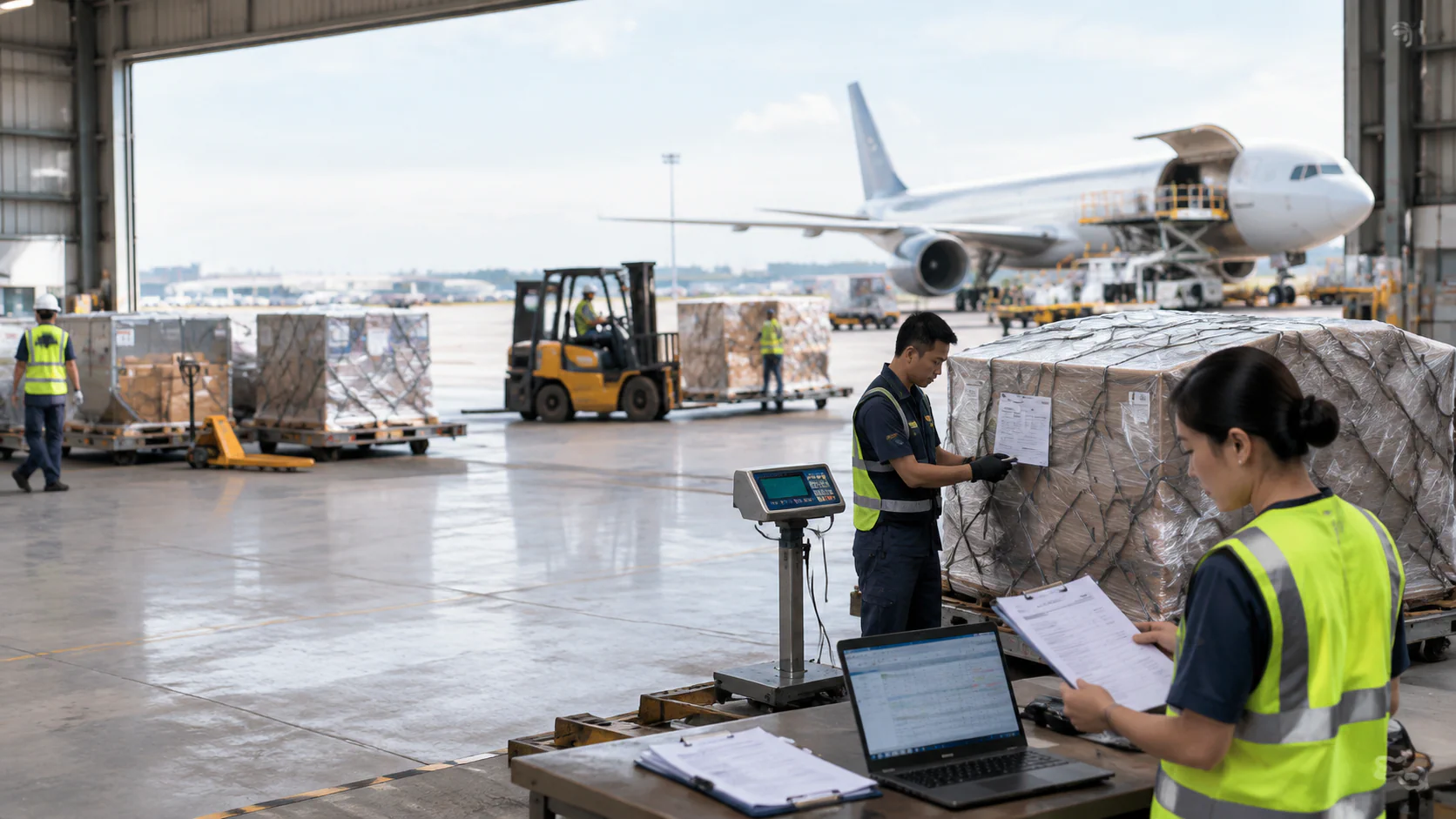
3.1. How to Calculate Chargeable Weight and Read Air Freight Rate Sheets
Chargeable Weight is the weight used to calculate freight charges, generally determined by selecting the higher value between Gross Weight and Volumetric Weight. Volumetric Weight is calculated from the package dimensions using the conversion factor applied by the airline or service provider.
Reference formula: Volumetric Weight (kg) = Length × Width × Height (cm) / 6,000. For example, a package measuring 60 × 50 × 40 cm has a volumetric weight of 20 kg. If its actual weight is 15 kg, the chargeable weight is generally 20 kg, before applying rounding rules and other relevant pricing conditions.
The 6,000 conversion factor is commonly used but does not automatically apply to every service. Businesses should confirm the applicable factor, rounding method, minimum chargeable weight, and actual measurements recorded at the air cargo terminal.
Air freight charges depend on the flight route, weight category, cargo type, transportation schedule, and available capacity. Fuel, security, and airport cargo handling surcharges can significantly affect the final cost.
When reading an air freight rate sheet, businesses should distinguish between rates for small shipments and weight breaks such as +45 kg, +100 kg, or +300 kg, where quoted. Comparisons must be based on the same route, quotation validity period, service conditions, and included charges rather than simply looking at the unit price per kilogram.
Total door-to-door costs may also include pickup charges, origin handling, customs declaration fees, destination handling charges, and domestic delivery costs. These items should be itemized in the quotation to avoid confusing basic air freight charges with the total cost of freight forwarding services.
3.2. The Process from Booking to Customs Clearance and Delivery
The international air freight process is generally organized into six steps, with documentation responsibilities and timelines established from the outset:
- Step 1 – Information Collection: Collect the cargo name, value, number of packages, dimensions, weight, departure and destination airports, required delivery schedule, and applicable Incoterms.
- Step 2 – Verification and Booking: Verify cargo acceptance availability, packaging requirements, restrictions on special cargo, flight schedules, and cut-off deadlines.
- Step 3 – Prepare the documentation: Complete the Invoice and Packing List; check the HS code, import-export policies, taxes, and specialized permits, if applicable.
- Step 4 – Cargo Handover: Measure and weigh the actual cargo, confirm the chargeable weight, review the draft air waybill, and resolve any discrepancies before issuance.
- Step 5 – Transportation and Customs Clearance: Complete export procedures and track the flight; at the destination, carry out customs declarations, fulfill tax obligations, and undergo specialized inspections where applicable.
- Step 6 – Cargo Collection and Document Retention: Check the number of packages and packaging condition, confirm delivery, and retain documents for future traceability or claims.
For dangerous goods, shipments containing lithium batteries, or temperature-controlled cargo, acceptance conditions and documentation must be reviewed according to specific requirements. The guidelines issued by the International Civil Aviation Organization (ICAO) are an important reference for aviation security, safety, and air cargo transportation procedures.
4. Air Freight Solutions and Document Control with G-LOGS JSC

Not every shipment needs to be transported by air. Businesses should evaluate delivery time, cargo characteristics, chargeable weight, and total costs before choosing air freight or FCL/LCL ocean freight. For urgent shipments, air transportation may be more suitable despite its higher cost.
G-LOGS JSC provides services, air freight integrated support for documentation, customs declarations, and domestic freight forwarding within the agreed service scope. Businesses can request MAWB/HAWB reviews, cross-checking of weighing and measurement data, clarification of cut-off deadlines, confirmation of document submission responsibilities, and a breakdown of additional charges.
To receive an accurate quotation, cargo owners should provide the departure and destination airports, cargo name and characteristics, number of packages, dimensions of each package, weight, expected shipping schedule, and pickup/delivery addresses. The quotation should separately specify basic freight charges, surcharges, service scope, and excluded costs.
Understanding what is an air waybill the air waybill correctly helps businesses minimize documentation errors while gaining better control over freight forwarding responsibilities and costs. Contact G-LOGS JSC for advice on suitable FCL/LCL, air freight, and customs declaration solutions for each shipment, with the goal of optimizing total logistics costs.
G-LOGISTICS TRADING AND SERVICES JOINT STOCK COMPANY (G-LOGS JSC)
Address: 4th Floor, Coalimex Building, 29–31 Dinh Bo Linh Street, Binh Thanh Ward, Ho Chi Minh City, Vietnam.
Phone: (84) 28 3511 5354/5455
Email: info@g-logs.com
Website: www.g-logs.com